The Upanishads
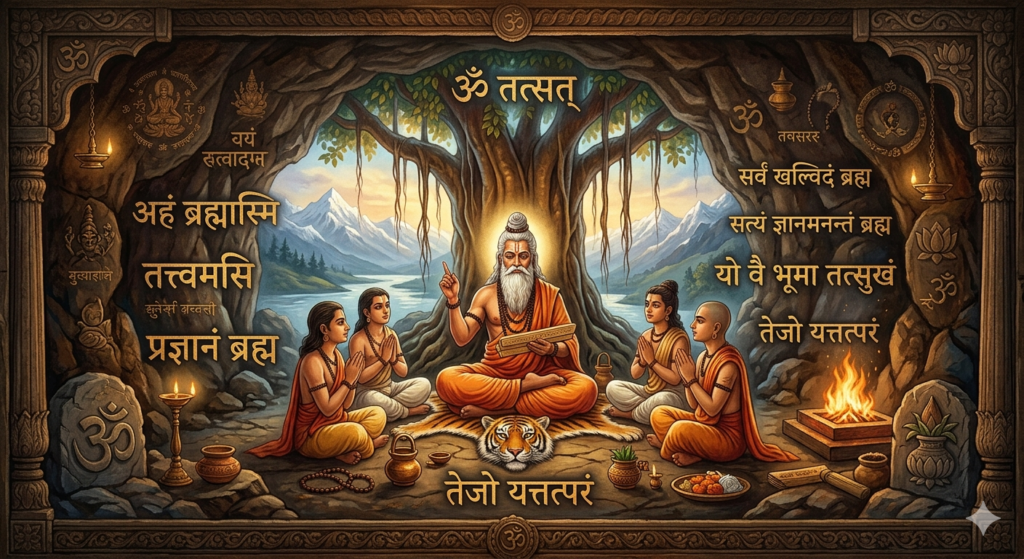
The Upanishads The Upanishads represent the peak of ancient Indian philosophical thought, forming the final section of the Vedas (often called Vedanta, meaning “the end of the Vedas”). Written primarily between 800 and 500 BCE, these sacred texts mark a dramatic shift away from external ritual sacrifices toward internal meditation and self-inquiry. The word itself literally translates to “sitting down near” a teacher, evoking the atmosphere of dedicated students gathering around a realized sage in forest hermitages to absorb confidential, spiritual truths about the nature of existence. At the absolute core of Upanishadic philosophy is a radical, non-dualistic discovery: the individual soul (Atman) is fundamentally identical to the ultimate, all-pervasive reality of the universe (Brahman). The texts argue that our daily suffering, fear, and entanglement in the endless cycle of birth and death (Samsara) stem from a deep spiritual blindness (Avidya). We mistake our temporary bodies, thoughts, and egos for our true identity. Through poetic dialogues, metaphors, and rigorous mental analysis, the Upanishads guide seekers to peel back the layers of human consciousness—mapping out the waking, dreaming, deep sleep, and transcendent witnessing states—to realize that the divine spark within us is the exact same infinite reality that sustains the entire cosmos. Ultimately, the Upanishads are not merely theoretical texts; they are highly practical maps for personal liberation (Moksha). They teach that true immortality is not achieved in a physical afterlife, but right here and now by untying the psychological “knots of the heart.” When a seeker shifts from chasing fleeting worldly pleasures to cultivating deep inner discernment and stillness, finite desires naturally dissolve. By realizing that we are not isolated waves but the ocean itself, fear vanishes entirely, giving way to absolute existence, consciousness, and bliss (Sat-Chit-Ananda). Here is a deeply focused, structured breakdown of the Upanishads, organized by key conceptual headings and essential topics. 1. The Core Metaphysical Architecture The Concept of Rita: The underlying cosmic and moral order that keeps the entire universe in balance. The Microcosm-Macrocosm Unity: The foundational idea that everything existing in the outer universe (Brahmanda) has a corresponding presence inside the human body (Pinda). Adhyatma, Adhibhuta, and Adhidaiva: A three-tiered framework used to analyze reality through the lens of the individual self, the physical world, and the subtle or divine forces. The Unmoving Mover: Deep philosophical inquiries into how the ultimate reality remains completely still and changeless, yet sets all cosmic creation, movement, and life into motion. 2. Advanced States of Human Consciousness The Mechanics of the Heart Space (Dahara Akasha): The subtle spiritual heart cavity, described as a tiny room where the infinite universe and the true self reside together. The Transition of Deep Sleep (Sushupti): An analysis of how the mind temporarily rests in a state of unmanifest bliss every night, serving as a daily glimpse of ultimate reality, though veiled by temporary ignorance. Turiya (The Witnessing Space): The fourth state of consciousness that exists beneath and throughout waking, dreaming, and deep sleep—unchanging, pure awareness. Prana and the Senses: The subtle vital energy that acts as the coordinator between physical organs and mental faculties, keeping the entire bodily system alive. 3.Epistemology: The Paths of Knowledge Para Vidya vs. Apara Vidya: The vital distinction between higher spiritual wisdom (which leads to self-realization) and lower material knowledge (which covers sciences, arts, grammar, and even ritual texts). The Role of Neti Neti: The classic method of intellectual negation (“not this, not that”) used to peel away every temporary object, thought, and identity until only pure consciousness remains. The Need for a Guru: Why text-based learning alone falls short, and why a living teacher who has walked the path is essential to awaken the latent spiritual truth within a seeker. The Three-Step Integration (Sravana, Manana, Nididhyasana): The complete learning process moving from actively listening to the truth, logically reflecting on it to clear away doubts, and finally meditating deeply upon it until it becomes real experience. 4. The Psychology of Human Bondage Avidya (Spiritual Blindness): The root cause of all suffering, where a person mistakes the temporary for the eternal, the painful for the pleasant, and the ego for the true self. The Knots of the Heart (Hridaya Granthi): The psychological and emotional blockages, deep-seated desires, and ego attachments that tether an individual to a limited identity. Kama (Desire) as the Driver of Samsara: How unfulfilled desires create a mental imprint, driving the soul to take on new physical forms cycle after cycle. The Illusion of Name and Form (Nama-Rupa): The understanding that the material world is a changing playground of different names and shapes given to the single, underlying reality. 5. Ethical Foundations & Practical Preparation Sadhana Chatushtaya: The four essential qualifications a seeker must cultivate before diving deep into ultimate inquiry: Viveka (Discernment between eternal truth and passing illusion). Vairagya (Dispassion for temporary pleasures). Shat-Sampat (Six mental virtues including calmness, self-control, and endurance). Mumukshutva (An intense, burning desire for absolute freedom). The Path of Preya vs. Shreya: The permanent choice every human faces between Preya (that which is instantly pleasant and comforting to the senses) and Shreya (that which is truly good, wholesome, and elevating for the soul). The Three Pillars of Ethical Action: Cultivating the core values of Dama (self-restraint), Datta (charity and giving), and Dayashva (deep compassion for all living beings). Satyatva (The Power of Absolute Truth): Truthfulness as the ultimate foundational pillar, famously summarized in the phrase Satyameva Jayate (Truth alone triumphs).
The Science of Gratitude
What is Gratitude? Think of your brain like a smartphone. Naturally, it has an old security app running in the background that is constantly looking for viruses, glitches, and threats. This is your brain’s negativity bias—an automatic habit of focusing on what is wrong, stressful, or annoying. Practicing gratitude is like downloading a brand-new update for your brain. It trains your mind to scan your day for the good stuff instead of just the bad. The 3-Step Science of How It Works- It Changes Your Brain Chemistry: When you notice something you appreciate, your brain instantly releases a rush of dopamine and serotonin. These are your body’s natural “feel-good” chemicals. They lift your mood, calm your thoughts, and lower your anxiety on the spot. It Shuts Off the Stress Alarm: When you are stressed, your body enters “fight-or-flight” mode, pumping out cortisol (the stress hormone) that makes your heart race and drains your energy. Feeling thankful flips a switch to “rest-and-digest” mode, which lowers your heart rate, relaxes your muscles, and lets your body heal. It Rewires Your Habits: Your brain is flexible. If you constantly complain, your brain gets really good at complaining. If you consciously practice gratitude, you build new neural pathways. Over time, noticing the positive elements of your life stops being an effort—it becomes your default setting The Golden Rule: Gratitude does not mean pretending everything is perfect. It just means remembering that even on a really bad day, there is always something small that is still good. The Simple Science- Your brain is naturally wired to notice problems. It acts like a camera that automatically zooms in on things that are stressful, annoying, or broken. This is a survival habit left over from thousands of years ago when humans had to look out for danger constantly. Gratitude is simply training your mind to zoom out. It is a daily practice that helps you see the whole picture, reminding you to notice the good things alongside the hard things. What Happens When You Practice Gratitude? A Natural Mood Boost: The exact moment you focus on something you appreciate, your brain releases a quick dose of dopamine and serotonin. These are your body’s built-in “happiness chemicals.” They instantly ease anxiety and make you feel lighter. A Calm Body: Stress pushes your body into an active “alarm state,” raising your heart rate and draining your energy. Feeling thankful signals to your nervous system that you are safe. It lowers your stress hormones, slows your heart, and helps your body relax. A Brain Rewire: Your brain adapts to your daily thoughts. If you spend your time focusing on complaints, your mind becomes an expert at finding flaws. If you practice looking for things to appreciate, you build new, positive pathways in your brain until noticing the good becomes an effortless habit. The Big Takeaway: Gratitude is not a fake smile, and it doesn’t mean ignoring your struggles. It just means remembering that even on a tough day, there is always something small to be thankful for. The Daily Impact of Gratitude- When you look at your life through the lens of gratitude, your entire daily experience begins to change. It transforms how you feel when you wake up, how you react to difficult moments, and how you interact with the people around you 3 Ways It Changes Your Day- Better Mornings: Starting your day by thinking of just one thing you appreciate sets a calm, positive tone. It prevents your mind from immediately jumping into a state of worry or rushing through your morning routine. Easier Connections: Telling someone you appreciate them changes the energy between you. It builds trust, deepens friendships, and makes your daily interactions feel much warmer and more supportive. Peaceful Evenings: Reflecting on the good parts of your day before going to sleep helps quiet your mind. It shifts your focus away from stress, allowing your body to truly relax and get a deeper, more restful night’s sleep. A Simple Shift: You do not need to change your life to practice gratitude. You just need to change where you choose to look.
The Fine Art of Alignment
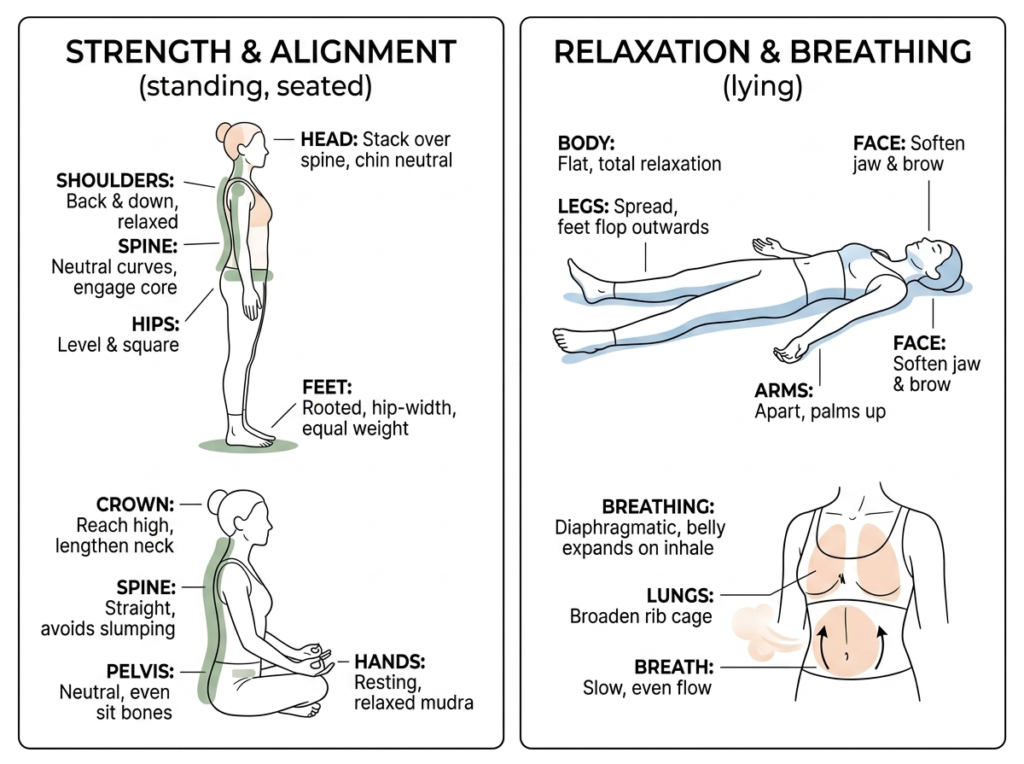
Mastering foundational yoga poses is all about the subtle details. Minor adjustments prevent injury and completely change how energy flows through your body. Here is how to fix common mistakes in your daily practice. Tadasana (Mountain Pose) The Mistake: Locking your knees rigidly, letting your lower back arch excessively, or shrugging your shoulders up toward your ears out of tension. The Fix: Ground down firmly through all four corners of your feet and keep a soft, micro-bend in your knees to protect the joints. Softly tuck your tailbone down toward the floor to engage your core, and roll your shoulders back and down away from your ears to lengthen your neck. Pro Tip: Imagine a string attached to the crown of your head gently pulling you upward toward the sky. This creates a beautifully long, spacious spine and builds a strong, steady foundation for your entire practice. Bhujangasana (Cobra Pose) The Mistake: Jamming your neck backward, straining your shoulders up toward your ears, and forcing all your weight into your hands—which pinches and crunches the lower spine. The Fix: Keep your palms light and flat on the mat directly under your shoulders. Keep your gaze facing forward or slightly down to ensure your neck stays long and comfortable. Instead of pushing with your arms, use the strength of your upper back muscles to gently peel your chest off the floor. Pro Tip: Keep your legs active by pressing the tops of your feet and your pubic bone firmly down into the mat. This stabilizes your base and protects your lower back from taking on too much pressure. Padmasana (Lotus Pose) The Mistake: Forcing your feet up onto your thighs when your hips are tight. This causes the knees to twist unnaturally, which can lead to severe joint strain. The Fix: Never force this pose. If your knees feel any pinching or discomfort, immediately switch to Ardha Padmasana (Half Lotus) by placing only one foot on top of the opposite thigh, or simply sit in Sukhasana (Easy Cross-Legged Pose). Pro Tip: To make sitting upright easier and more comfortable for your lower back, place a folded blanket or a firm cushion under your sitting bones. This tilts your pelvis forward and opens up your hips naturally. Trikonasana (Triangle Pose) The Mistake: Collapsing your chest forward and straining to touch the floor with your lower hand. This pinches the side waist and loses the open stretch. The Fix: Focus on keeping your torso open to the side, as if your back is resting against a wall. Instead of reaching for the floor, place your hand on your shin, ankle, or a yoga block. Keep your top shoulder rolled back and your chest open. Pro Tip: Press firmly into the outer edge of your back foot to stay grounded, stable, and strong throughout the pose. Ustrasana (Camel Pose) The Mistake: Sinking into the lower back and letting your hips sag backward toward your heels. The Fix: Keep your hips stacked directly in line over your knees. Press your shin bones firmly down and lift your sternum (chest bone) toward the sky to create a spacious backbend. Safe Transition Tip: When exiting deep backbends like Camel Pose, always come out slowly. Bring your hands back to your hips first, tuck your chin, and use your core strength to lift yourself up. Avoid sudden, jerky movements. Vrikshasana (Tree Pose) The Mistake: Placing the foot of your lifted leg directly against the side of your opposite knee joint. Pushing sideways into the knee can cause serious joint strain. The Fix: Place your lifted foot either entirely above the knee (on the inner thigh) or entirely below the knee (on the inner calf). If balancing is difficult today, you can even rest your heel against your ankle with your toes touching the floor like a kickstand. Pro Tip: Find a still, unmoving point on the wall or floor in front of you to focus your gaze (Drishti). This instantly brings stability to your balance and calm to your mind. Ardha Chakrasana (Half Wheel Pose) The Mistake: Letting your knees bend, dropping your head backward too quickly, or compressing your lower spine without supporting it. The Fix: Place your palms firmly on your lower back or hips with your fingers pointing downward to support your spine. Keep your legs straight and engage your thighs. Instead of just bending backward, focus on lifting your chest upward toward the ceiling before gently leaning back. Safe Transition Tip: Keep your neck comfortable—look backward only if it does not strain your neck. When coming out of the pose, use your abdominal strength to slowly bring your torso back to center on an inhale, keeping your hands on your lower back for stability. Shavasana (Corpse Pose) The Mistake: Treating this final pose as just “lying down” or letting your mind drift into your daily to-do list. Physically, fidgeting or keeping your body tense prevents the nervous system from resetting. The Fix: Give yourself permission to be completely still. Let your feet drop open naturally to the sides and turn your palms up toward the sky. Soften your jaw, relax the space between your eyebrows, and let your body feel completely heavy on the mat. Pro Tip: If your lower back feels any discomfort while lying flat, place a rolled-up blanket or a pillow under your knees. This instantly releases tension in the lower spine, allowing you to sink deeper into relaxation.