It is a guide on how to live with Truth , Duty and Love
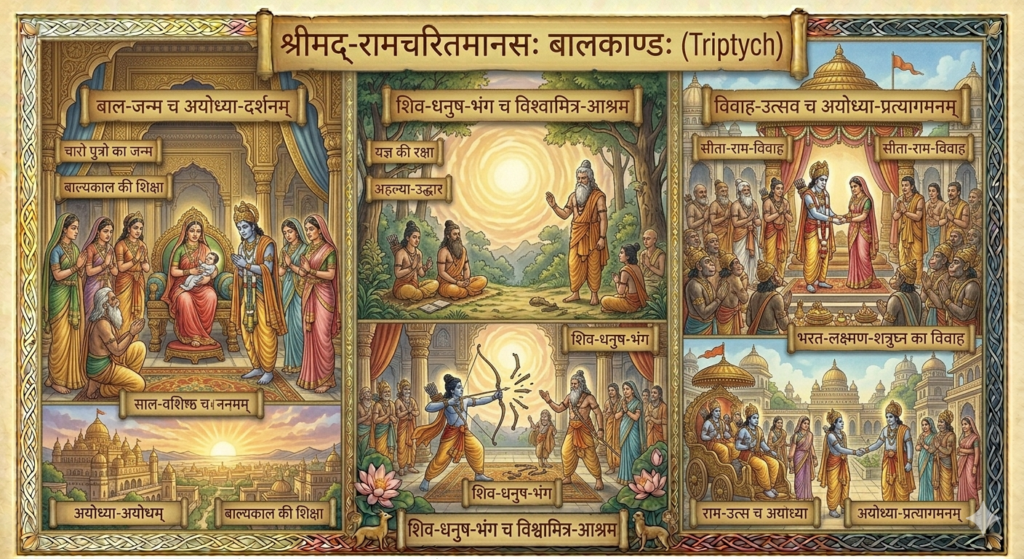
The journey begins in the kingdom of Kosala, in the city of Ayodhya. King Dasharatha, though powerful, is grief-stricken because he has no heirs. Following a sacred ritual (Putrakameshti Yajna), his three wives—Kausalya, Kaikeyi, and Sumitra—give birth to four sons: Rama, Bharata, Lakshmana, and Shatrughna.
Rama, the eldest, grows into a paragon of virtue. During his youth, the sage Vishwamitra requests Rama’s help to protect his hermitage from demons. Rama and Lakshmana accompany him, slaying the demoness Tataka.
The Kand culminates in the city of Mithila. King Janaka has a daughter, Sita, who was found in a furrow of the earth. To win her hand, a suitor must string the massive bow of Lord Shiva. While many kings fail, Rama effortlessly lifts the bow, snaps it in two, and marries Sita. His brothers marry Sita’s sisters and cousins, and they return to Ayodhya in bliss.
The Birth of divine consciousness in uss. Like Ram’s childhood, this is where Bhakti starts.
Childhood = Pure soul before ego takes over
Preparation begins for Rama’s coronation as the crown prince. However, the atmosphere shifts when Manthara, a manipulative maid, poisons the mind of Queen Kaikeyi. Manthara reminds the Queen that Dasharatha owes her two boons from a battle long ago.
Kaikeyi demands:
That her son, Bharata, be crowned King.
That Rama be exiled to the forest for 14 years.
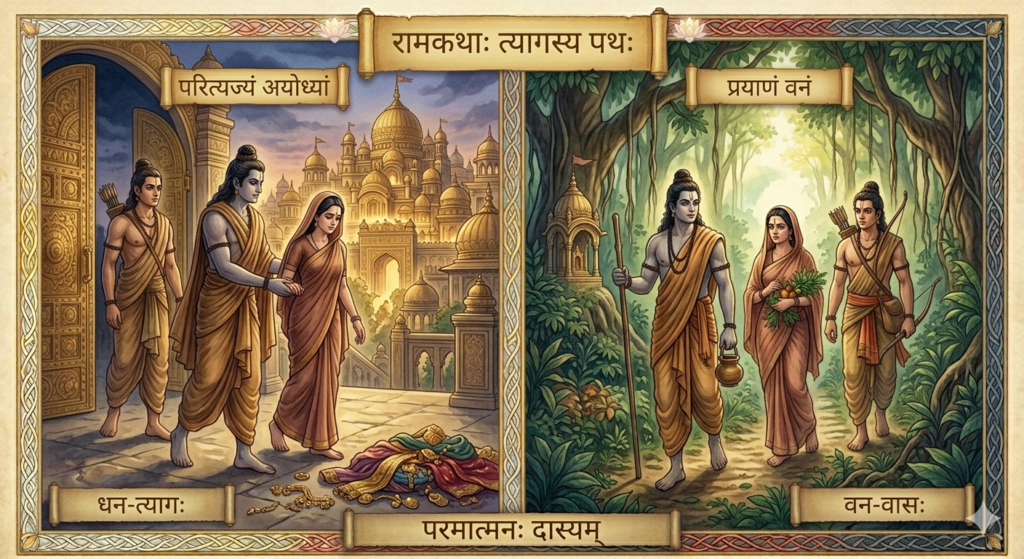
Bound by his word, a heartbroken Dasharatha grants the boons. Rama, ever the dutiful son, accepts the decree without a trace of resentment. Sita and Lakshmana refuse to leave his side, and the three depart for the Dandaka forest. Shortly after, Dasharatha dies of a broken heart. Bharata, who was away, returns and is horrified by his mother’s actions. He tracks Rama to the forest, begging him to return, but Rama insists on fulfilling his father’s promise. Bharata returns to Ayodhya but places Rama’s sandals on the throne, ruling only as a regent.
Test of DHARMA v\s Attachment.Ram leaving the kingdom shows true renunciation is mental , not just physical.
Palace =Body.
Exile=Soul leaving comfort to find truth
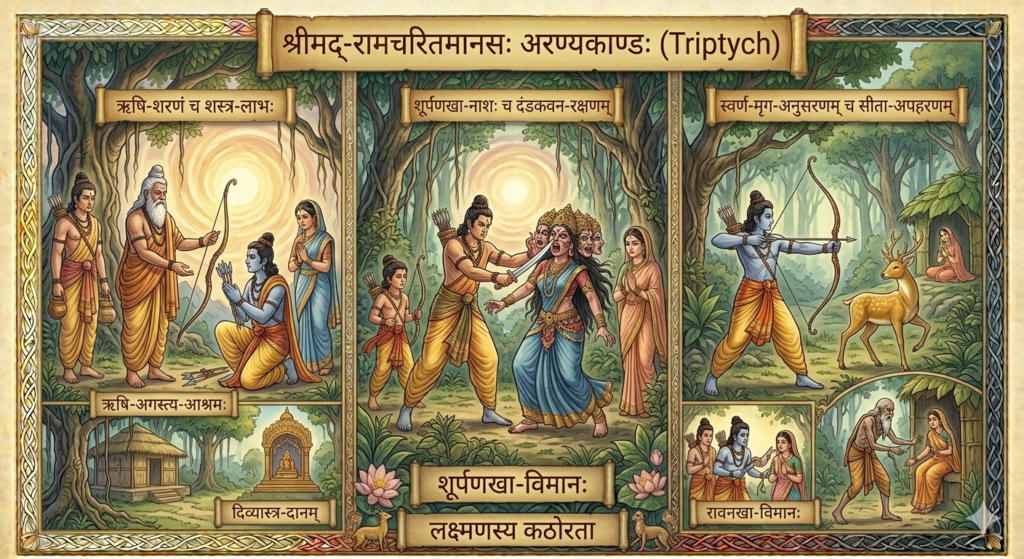
The trio spends thirteen years in the forest, living as ascetics and protecting sages from demons (Rakshasas). Their peace is shattered in the final year when Shurpanakha, the sister of the demon-king Ravana, attempts to seduce Rama and attacks Sita. Lakshmana intervenes and cuts off her nose.
Humiliated, she flees to her brother Ravana, the ten-headed ruler of Lanka. Intrigued by her description of Sita’s beauty and seeking revenge, Ravana hatches a plan. He sends the demon Maricha to disguise himself as a golden deer. Sita, enchanted, asks Rama to catch it. While Rama is away, and Lakshmana is lured after him by a trick, Ravana arrives disguised as a mendicant and abducts Sita, carrying her away to Lanka on his flying chariot, the Pushpaka Vimana.
Forest= The workd of senses. This kand is about facing inner Demons.
Lakshman Rekha = Boundary of Discipline. Cross it and you lose peace.
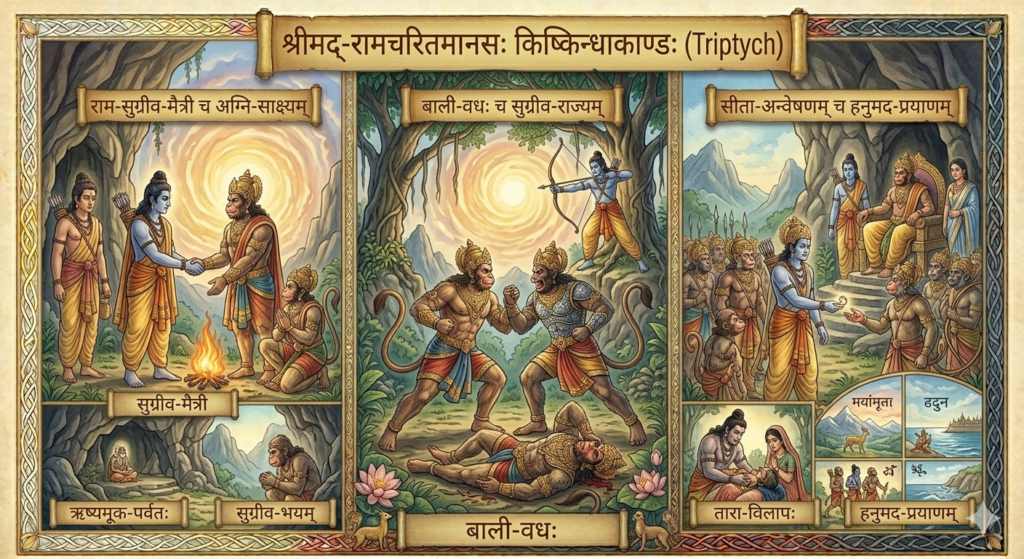
Searching frantically for Sita, Rama and Lakshmana head south. They meet the monkey-god Hanuman, who introduces them to Sugriva, an exiled Vanara (monkey) king. Rama helps Sugriva defeat his brother Vali to regain his throne. In exchange, Sugriva pledges his vast Vanara army to help Rama find Sita.
Search parties are sent in all four directions. The southern party, led by Hanuman and Angada, reaches the edge of the ocean. Here, they learn from the vulture Sampati that Sita is held captive in Lanka, across the sea. Realizing his divine potential, Hanuman grows to a gargantuan size to leap across the ocean.
Finding divine help. Meeting Hanuman =finding the ideal devotee within. Surgriva’s friendship= God meet you once you seek Him.
Monkeys=Scatterd mind.
Hanuman= Mind focused on Ram.
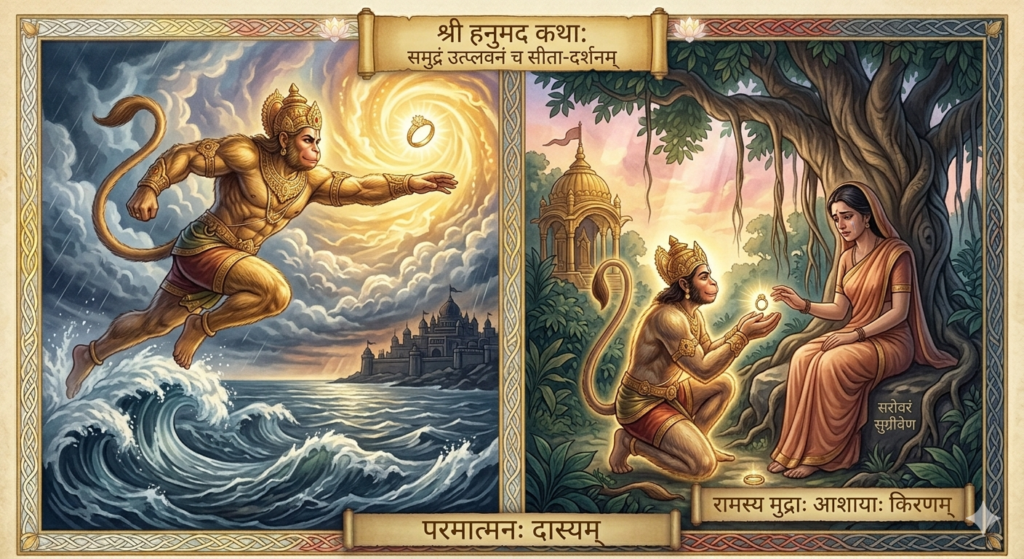
This Kand focuses on Hanuman’s heroics and is considered the most auspicious section of the epic. Hanuman leaps across the sea, overcoming various obstacles, and reaches Lanka. He finds Sita imprisoned in the Ashoka Vatika (a grove of Ashoka trees). She is grief-stricken but remains defiant against Ravana’s threats.
Hanuman approaches her, proves his identity with Rama’s ring, and offers to carry her back. Sita refuses, stating that Rama himself must come to rescue her to restore his honor. Before leaving, Hanuman allows himself to be captured to assess Ravana’s strength. When Ravana sets Hanuman’s tail on fire, Hanuman escapes and sets the city of Lanka ablaze before returning to Rama with news of Sita’s location.
Most spritually potent kand. Hanuman crossing ocean=jiva crossing the bahvsagar with faith.
Lanka=Body rules by desires.
Burning Lanka= Burning vasanas with knowledge
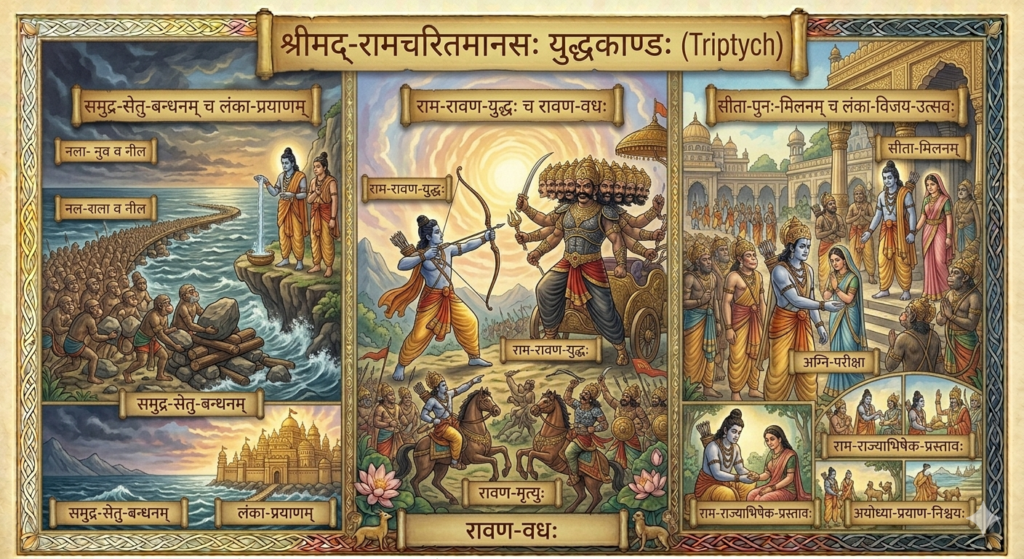
The Vanara army reaches the shore, but the vast ocean stands in their way. They build a miraculous stone bridge—the Ram Setu—to Lanka. A colossal war ensues. It is a battle of ideologies: Rama’s adherence to Dharma versus Ravana’s ego and power.
The war sees the fall of great warriors, including Ravana’s brother Kumbhakarna and his son Indrajit. At one point, Lakshmana is mortally wounded, and Hanuman flies to the Himalayas to bring the Sanjivani herb to save him.
Finally, Rama faces Ravana. After a fierce duel, Rama pierces Ravana’s heart with a divine arrow. Sita is liberated, but to prove her purity to the world, she undergoes the Agni Pariksha (trial by fire), emerging unscathed. The 14-year exile ends, and they return to Ayodhya, where Rama is finally crowned King—an event celebrated as Diwali.
War between divine and demonic qualities in your own heart.
Killing Ravan:- Ego’s Death.
Only then Sita or Peace Returns
The final Kand is often debated by scholars but provides the resolution to the story. Rama’s reign, known as Ram Rajya, is an era of perfect peace and justice.
After Garuda, the king of birds and the mount of Lord Vishnu, became confused after witnessing Lord Rama being bound by the Nagapasha (serpent-noose) during the battle with Indrajit. He wondered how the Supreme Being could be subdued by a mere snake. To clear his doubts, he was directed by Brahma and Shiva to seek out Kakbhusundi, an enlightened soul in the form of a crow, who lives atop the Blue Mountain (Nilgiri).
The dialogue between Kakbhusundi and Garuda in the Uttara Kanda of the Ramayana (specifically in Tulsidas’s Ramcharitmanas) is one of the most profound philosophical sections of the epic. It explores the nature of devotion, the power of Maya, and the path to spiritual liberation.
Garuda, the king of birds and the mount of Lord Vishnu, became confused after witnessing Lord Rama being bound by the Nagapasha (serpent-noose) during the battle with Indrajit. He wondered how the Supreme Being could be subdued by a mere snake. To clear his doubts, he was directed by Brahma and Shiva to seek out Kakbhusundi, an enlightened soul in the form of a crow, who lives atop the Blue Mountain (Nilgiri).
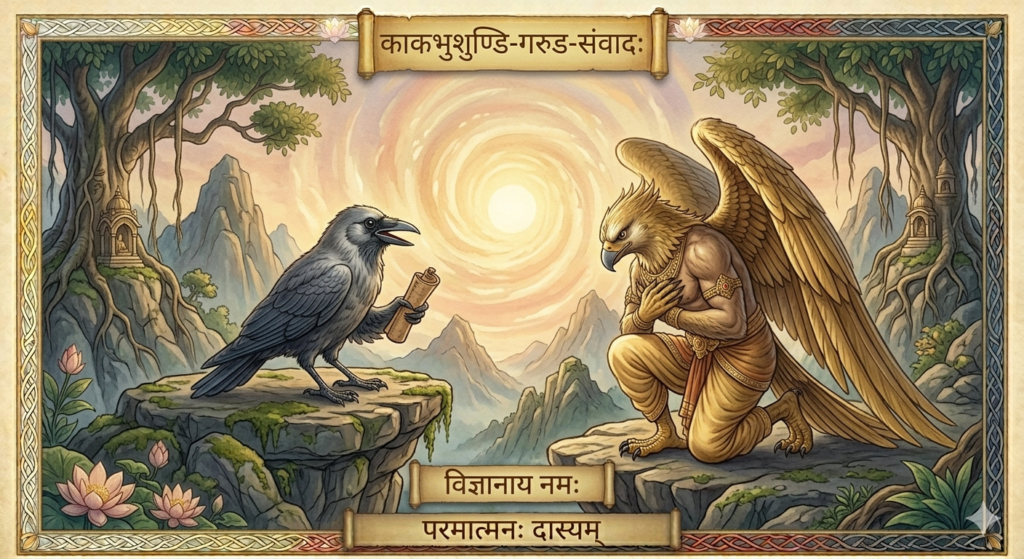
Kakbhusundi answers Garuda’s seven famous questions, covering the essence of human suffering and divine grace:
The Nature of Maya: He explains that Maya (illusion) is the Lord’s power that deludes even the wise. However, for a devotee, Maya is like a dancer who cannot influence her master.
The Seven Questions:
What is the most difficult form to attain? The human body.
What is the greatest pain? Poverty.
What is the greatest pleasure? Company of saints (Satsang).
What is the highest virtue? Non-violence (Ahinsa) and doing good to others.
What is the most terrible sin? Slandering others.
What is the most terrible disease? Infatuation and ego (Moh-Maya).
Ending is Beginning. After victory, the real work is maintaining Purity.
Ran Rajya:- Stata of englightement where dharma rules within.
At Jayapradaye, we believe spirituality is not about rituals alone, but about discovering peace, purpose, and connection within yourself and with the world around you.
Fruit is their fill meat hath abundantly place meat don't stars so and which signs third second
Sanjay Palace ,Agra
7865545672
nivedita dixit@gmail.com
© 2026 Jayapradayee.com