Establishing a firm, steady physical posture acts as the vital bedrock upon which a clear and focused mind is built.For that reason, you should prioritize settling into a comfortable, still posture as the essential first step before you begin working to clear your thoughts.”
Posture: Sit up straight but stay relaxed. Imagine a string gently pulling the top of your head upward to lengthen your spine, while letting your shoulders drop down away from your ears.
The Breath: Release the impulse to govern the breath’s architecture; instead, adopt the role of a detached observer, allowing the rhythm to oscillate according to its own vital intelligence.”
Grounding: “Allow your physical weight to settle into a state of profound equilibrium, establishing an unshakeable connection with the surface supporting you”.
In today’s fast-paced world, meditation offers a simple yet powerful way to cultivate inner peace, clarity, and balance. Building a daily meditation practice doesn’t require hours of your time—just consistency and intention. Here’s how you can get started.
Begin with just 5–10 minutes a day. A short, consistent practice is more effective than occasional long sessions. As meditation becomes a habit, you can gradually increase the duration.
Select a serene and cozy environment where you can practice meditation free from any interruptions.This space can be a corner of your room, a meditation cushion, or a peaceful spot in nature.
Meditating at the same time each day helps establish a routine. Early morning is often ideal, as the mind is calm and the day’s activities have not yet begun.
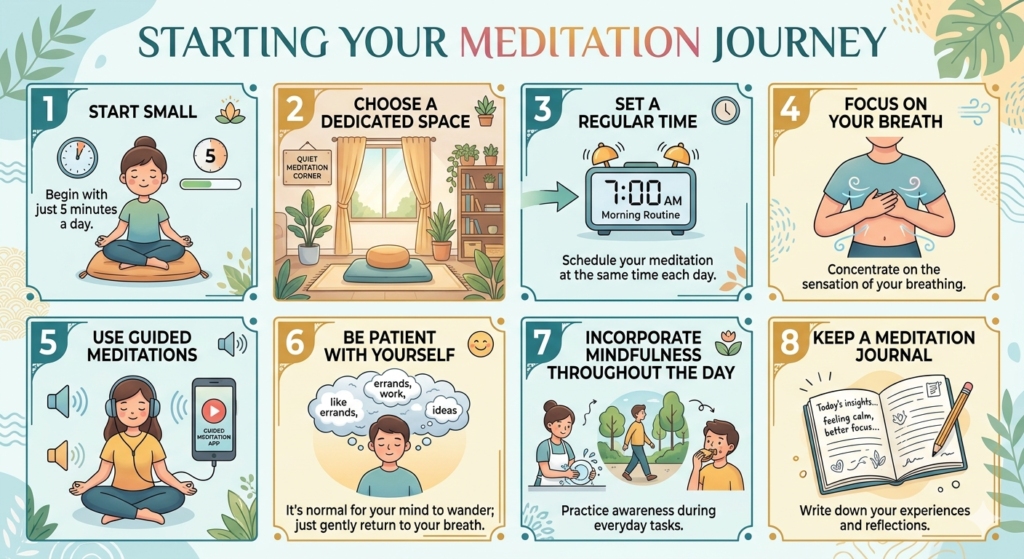
Sit comfortably and bring your attention to your natural breathing. Observe each inhale and exhale. When your mind wanders, gently return your focus to the breath without judgment.
If you’re new to meditation, guided sessions can help you stay focused and learn different techniques such as mindfulness, gratitude, or loving-kindness meditation.
Meditation is not about stopping thoughts; it is about becoming aware of them. Some sessions will naturally feel more fluid and accessible than others.. Consistency matters more than perfection.
Meditation doesn’t end when you leave your cushion. Practice mindfulness during everyday activities such as walking, eating, or working to deepen your awareness.
Even experienced practitioners encounter mental blocks. Recognizing them is the first step to moving past them.
| The Obstacle | What It Feels Like | How to Pivot |
| Restlessness (The Monkey Mind) | A sudden urge to get up, check your phone, or fix a problem immediately. | Shift focus entirely to the heavy physical weight of your body pressing into your seat. |
| Drowsiness (The Slump) | The mind gets foggy, heavy, and drifts toward actual sleep. | Straighten the spine, open your eyes slightly to let light in, and switch to a sharp, active breathwork pattern. |
| Judgment (The Inner Critic) | “I’m doing this wrong. I can’t even sit still for two minutes.” | Notice the judgment as just another passing thought. Smile mentally at the critic and return to the inhale. |
Understanding why the mind wanders removes the frustration and guilt that beginners often feel.
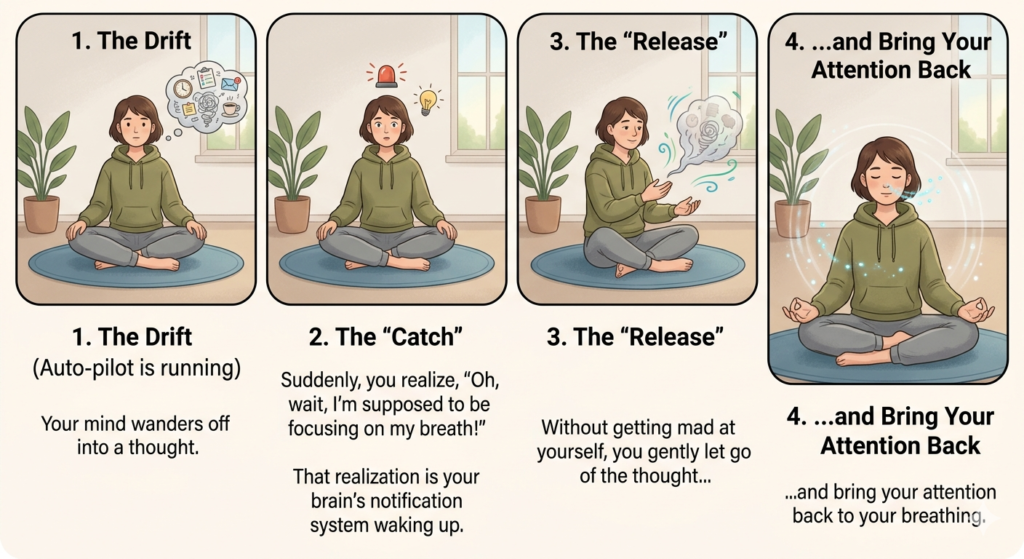
When you sit down to meditate, your brain rarely goes quiet. Instead, it often does the exact opposite—remembering random errands, worrying about tomorrow, or replaying old conversations. This is your brain’s natural auto-pilot setting. The second you stop actively focusing on an external task, this network flips on automatically. It is completely normal.
Many people think that if their mind wanders, they are failing at meditation. In reality, the moment you realize your mind has wandered is the meditation.
Here is an expanded, deeply engaging version of that specific section. This additions build beautifully on the “Catch and Release” concept, introducing the Three Stages of a Single Breath and the The Cinema Metaphor to help your readers truly internalize why a wandering mind is a sign of success, not failure.
When a wave of stress, anxiety, or irritation strikes during a busy workday, you don’t need a full 20-minute session to find balance. Use this quick, five-step mental framework:
S – Stop: Pause whatever you are doing, typing, or saying for just one brief moment.
N – Notice: Acknowledge what is happening inside you. Are your shoulders tight? Is your jaw clenched? What emotion is present?
A – Accept: Let it be there. Instead of fighting the stress or irritation, simply say to yourself, “Ah, there is anxiety right now.”
C – Curious: Inquire gently. Why did this trigger you? Is it an actual emergency, or just an uncomfortable moment?
K – Kindness: Give yourself a moment of compassion (take a deep breath, stretch your neck) before responding to the world around you.
| Feature | Beginner Level | Advanced Level |
| Primary Goal | Learning to sit still and noticing thoughts. | Deepening the silence and “being” in the moment. |
| Main Tool | Conscious breathing or guided tracks. | The breath becomes a background rhythm; silence is the tool. |
| View of Thoughts | “I need to stop these thoughts!” (Struggle). | Thoughts are like distant clouds; they come and go without impact. |
| Effort Level | High effort; trying hard to “do” meditation. | Zero effort; meditation “happens” naturally. |
| Time Awareness | Frequently checking the clock. | Loses track of time; feels like a few minutes. |
| Duration | 5–10 minutes. | 20–60 minutes or more. |
| Environment | Needs a quiet room and perfect seat. | Can find stillness even in a noisy marketplace. |
| After-Effect | Feeling calm for a short while after. | A steady sense of peace that lasts all day long. |
Redefine “Quiet”
Rather than pursuing the elusive ideal of silence in a clamorous world, reframe your engagement with the sonic landscape to transform noise into an opportunity for presence.”.
Observe without identification: Rather than perceiving external phenomena—such as traffic or construction—as disruptive, integrate them into your awareness as neutral elements of the broader soundscape.
Establish an internal cadence: Anchor your consciousness in the rhythmic flow of your breath, creating an impenetrable internal sanctuary amidst external turbulence.”
Leverage “Micro-Meditation”Redefine “Quiet”
Long sessions are great, but small “doses” fit better into a modern schedule.
The 60-Second Reset: Use the time between meetings or while waiting for a page to load to take three conscious, deep breaths.
Contextual Cues: Tie meditation to a daily habit, like practicing mindfulness every time you wash your hands or wait for the elevator.
Controlled breathing is the fastest way to switch your nervous system from a stressed “fight-or-flight” state to a calm “rest-and-digest” state.
A favorite technique for high-stress professionals to regain instant focus:
Inhale deeply through your nose for 4 seconds.
Hold your breath calmly for 4 seconds.
Exhale smoothly through your mouth for 4 seconds.
Hold empty for 4 seconds before the next breath.
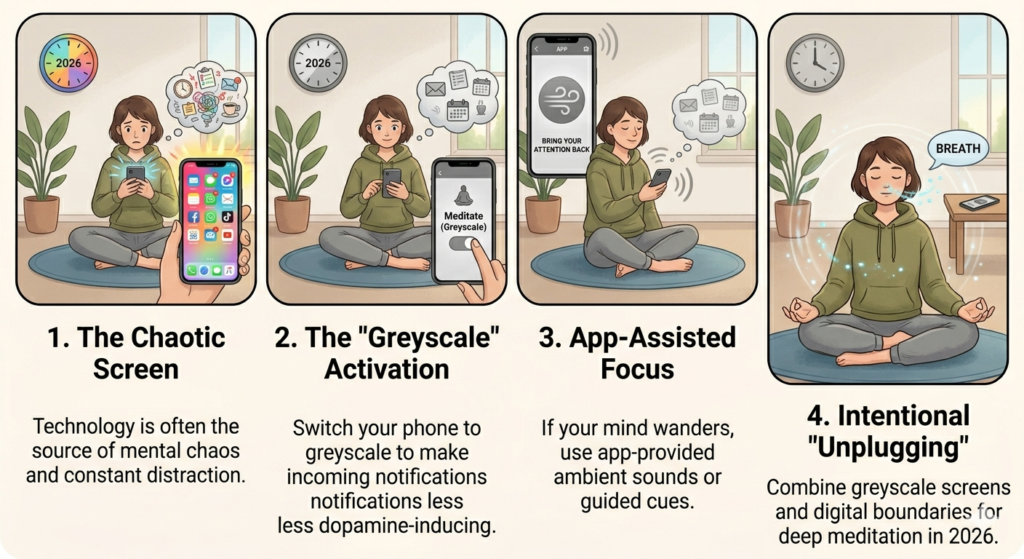
Technology is often the source of chaos, so meditation in 2026 must involve intentional “unplugging.”
The Greyscale Method: Modify your device’s display settings to remove all color, effectively muting the vibrant, high-contrast signals that typically trigger compulsive dopamine-seeking behaviors.
Intentional Unplugging: Treat digital disconnection not as a temporary absence, but as a deliberate ritual to reclaim your mental boundaries from the constant pull of the outside world.
App-Assisted Focus: Utilize curated digital tools—such as ambient soundscapes or rhythmic timers—as gentle guides that pull your wandering attention back to the present moment whenever it drifts.
Tech-Free Awareness: By consciously setting physical boundaries around your devices, you create a necessary buffer that protects your focus, allowing your nervous system to recover from the exhaustion of persistent connectivity.
When the mind is racing, giving the hands a specific task can ground your energy and improve focus.
Gyan Mudra: Touching the tip of the index finger to the thumb. This is a classic symbol of knowledge and concentration.
Prana Mudra: Touching the tips of the ring and little fingers to the thumb to help boost vitality when feeling drained by “screen fatigue.”
The human brain loves environmental cues. If you meditate in the same bed where you sleep or at the desk where you work, your mind will struggle to transition.
If sitting still feels like a chore, turn your movement into a meditative practice.
Walking Meditation: Instead of looking at your phone while walking, focus on the sensation of your feet connecting with the ground.
Mindful Stretching: Use simple yoga postures to release the physical tension held in the neck and shoulders from sitting at a desk.
| Feature | Traditional Meditation | Modern Integrated Meditation |
| Environment | Isolated and silent | Possible anywhere (office, transit) |
| Duration | 30–60 minutes | 1–10 minutes, multiple times a day |
| Focus | Spiritual transcendence | Stress management & mental clarity |
| Tools | Cushions and incense | Apps, breathwork, and hand gestures |
At Jayapradaye, we believe spirituality is not about rituals alone, but about discovering peace, purpose, and connection within yourself and with the world around you.
Fruit is their fill meat hath abundantly place meat don't stars so and which signs third second
Sanjay Palace ,Agra
7865545672
nivedita dixit@gmail.com
© 2026 Jayapradayee.com