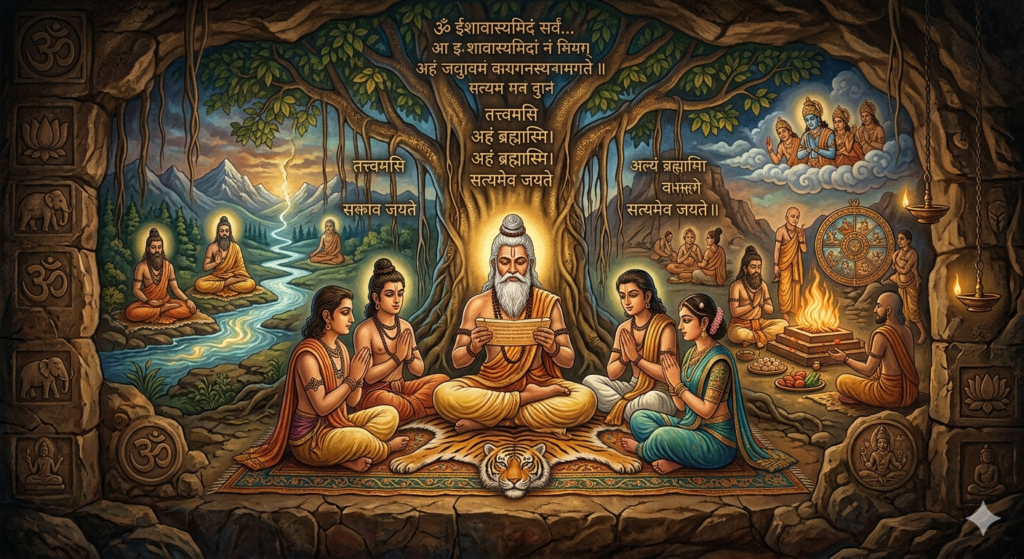
The Upanishads represent the peak of ancient Indian philosophical thought, forming the final section of the Vedas (often called Vedanta, meaning “the end of the Vedas”). Written primarily between 800 and 500 BCE, these sacred texts mark a dramatic shift away from external ritual sacrifices toward internal meditation and self-inquiry. The word itself literally translates to “sitting down near” a teacher, evoking the atmosphere of dedicated students gathering around a realized sage in forest hermitages to absorb confidential, spiritual truths about the nature of existence.
At the absolute core of Upanishadic philosophy is a radical, non-dualistic discovery: the individual soul (Atman) is fundamentally identical to the ultimate, all-pervasive reality of the universe (Brahman). The texts argue that our daily suffering, fear, and entanglement in the endless cycle of birth and death (Samsara) stem from a deep spiritual blindness (Avidya). We mistake our temporary bodies, thoughts, and egos for our true identity. Through poetic dialogues, metaphors, and rigorous mental analysis, the Upanishads guide seekers to peel back the layers of human consciousness—mapping out the waking, dreaming, deep sleep, and transcendent witnessing states—to realize that the divine spark within us is the exact same infinite reality that sustains the entire cosmos.
Ultimately, the Upanishads are not merely theoretical texts; they are highly practical maps for personal liberation (Moksha). They teach that true immortality is not achieved in a physical afterlife, but right here and now by untying the psychological “knots of the heart.” When a seeker shifts from chasing fleeting worldly pleasures to cultivating deep inner discernment and stillness, finite desires naturally dissolve. By realizing that we are not isolated waves but the ocean itself, fear vanishes entirely, giving way to absolute existence, consciousness, and bliss (Sat-Chit-Ananda).
The Concept of Rita: The underlying cosmic and moral order that keeps the entire universe in balance.
The Microcosm-Macrocosm Unity: The foundational idea that everything existing in the outer universe (Brahmanda) has a corresponding presence inside the human body (Pinda).
Adhyatma, Adhibhuta, and Adhidaiva: A three-tiered framework used to analyze reality through the lens of the individual self, the physical world, and the subtle or divine forces.
The Unmoving Mover: Deep philosophical inquiries into how the ultimate reality remains completely still and changeless, yet sets all cosmic creation, movement, and life into motion.
The Mechanics of the Heart Space (Dahara Akasha): The subtle spiritual heart cavity, described as a tiny room where the infinite universe and the true self reside together.
The Transition of Deep Sleep (Sushupti): An analysis of how the mind temporarily rests in a state of unmanifest bliss every night, serving as a daily glimpse of ultimate reality, though veiled by temporary ignorance.
Turiya (The Witnessing Space): The fourth state of consciousness that exists beneath and throughout waking, dreaming, and deep sleep—unchanging, pure awareness.
Prana and the Senses: The subtle vital energy that acts as the coordinator between physical organs and mental faculties, keeping the entire bodily system alive.
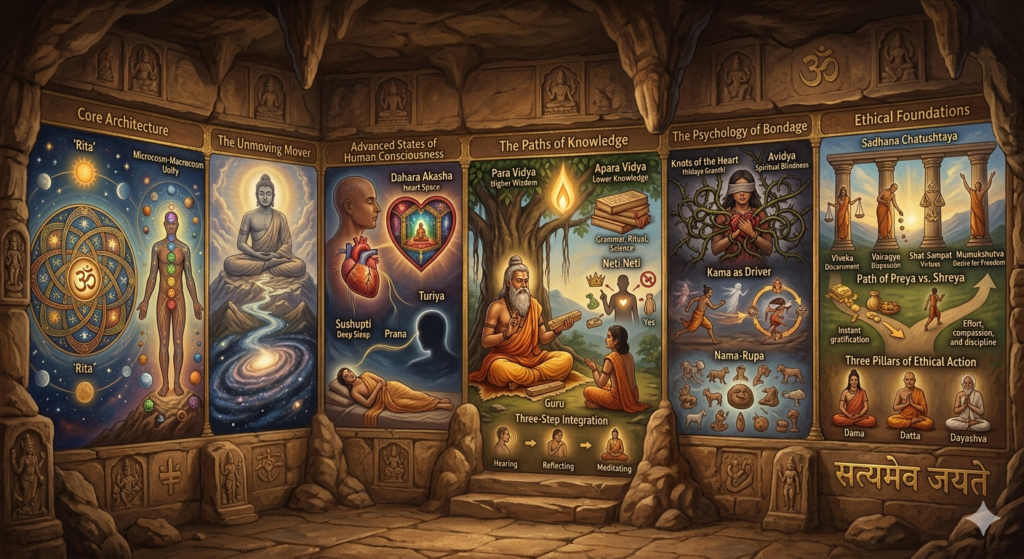
Para Vidya vs. Apara Vidya: The vital distinction between higher spiritual wisdom (which leads to self-realization) and lower material knowledge (which covers sciences, arts, grammar, and even ritual texts).
The Role of Neti Neti: The classic method of intellectual negation (“not this, not that”) used to peel away every temporary object, thought, and identity until only pure consciousness remains.
The Need for a Guru: Why text-based learning alone falls short, and why a living teacher who has walked the path is essential to awaken the latent spiritual truth within a seeker.
The Three-Step Integration (Sravana, Manana, Nididhyasana): The complete learning process moving from actively listening to the truth, logically reflecting on it to clear away doubts, and finally meditating deeply upon it until it becomes real experience.
Avidya (Spiritual Blindness): The root cause of all suffering, where a person mistakes the temporary for the eternal, the painful for the pleasant, and the ego for the true self.
The Knots of the Heart (Hridaya Granthi): The psychological and emotional blockages, deep-seated desires, and ego attachments that tether an individual to a limited identity.
Kama (Desire) as the Driver of Samsara: How unfulfilled desires create a mental imprint, driving the soul to take on new physical forms cycle after cycle.
The Illusion of Name and Form (Nama-Rupa): The understanding that the material world is a changing playground of different names and shapes given to the single, underlying reality.
Sadhana Chatushtaya: The four essential qualifications a seeker must cultivate before diving deep into ultimate inquiry:
Viveka (Discernment between eternal truth and passing illusion).
Vairagya (Dispassion for temporary pleasures).
Shat-Sampat (Six mental virtues including calmness, self-control, and endurance).
Mumukshutva (An intense, burning desire for absolute freedom).
The Path of Preya vs. Shreya: The permanent choice every human faces between Preya (that which is instantly pleasant and comforting to the senses) and Shreya (that which is truly good, wholesome, and elevating for the soul).
The Three Pillars of Ethical Action: Cultivating the core values of Dama (self-restraint), Datta (charity and giving), and Dayashva (deep compassion for all living beings).
Satyatva (The Power of Absolute Truth): Truthfulness as the ultimate foundational pillar, famously summarized in the phrase Satyameva Jayate (Truth alone triumphs).
At Jayapradaye, we believe spirituality is not about rituals alone, but about discovering peace, purpose, and connection within yourself and with the world around you.
Fruit is their fill meat hath abundantly place meat don't stars so and which signs third second
Sanjay Palace ,Agra
7865545672
nivedita dixit@gmail.com
© 2026 Jayapradayee.com