
Bhagavad Gita teaches duty, wisdom, self-discipline, and the path to a meaningful life through a dialogue between Arjuna and Krishna.
In the First Arjuna Vishada Yoga, Arjuna feels fear, sadness, and confusion before the battle of KurukshetraArjuna becomes emotionally disturbed after seeing his own relatives, teachers, and loved ones standing on the opposite side of the battlefield.
The first chapter of Bhagavad Gita — teaches that spirituality begins when a person faces inner confusion, emotional pain, and starts seeking truth, wisdom, and guidance for the soul.
In the second chapter Sankhya Yoga, Krishna teaches Arjuna that the soul is eternal and never dies, and true spirituality comes from controlling the mind, doing one’s duty without attachment, and staying calm in every situation.
Sankhya teaches separation. By practicing quiet observation, you step back and say: “I am experiencing this body, this thought, and this emotion, but I am not them. I am the silent soul watching it all.”
In short, it is the ultimate path to emotional sovereignty. Reclaiming your true inner self immediately quietens the mind and brings lasting peace.
True devotion to duty lies in dedicating your complete effort to the action itself, leaving the outcome entirely to a higher purpose. When you shift your focus from personal reward to selfless service, every daily task transforms into a sacred offering. Excellence is found in the integrity of your effort, entirely free from the anxiety of praise or success. By letting go of the fruits of your labor, you find a steady inner peace that outer circumstances can never disturb.
Krishna explains that no one can remain without action, so instead of avoiding work, one should perform their duties (dharma) sincerely.
He also emphasizes working for the welfare of society (Lokasangraha) and setting a good example for others. By controlling desires, ego, and senses, and dedicating all actions to God, a person can purify the mind.
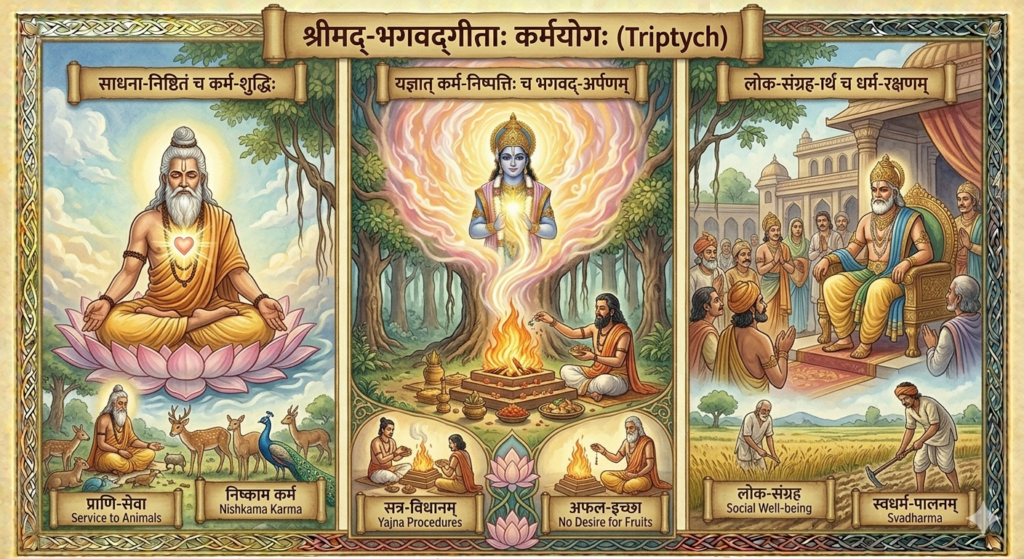
In the Fourth Chapter, Lord Krishna explains the deep connection between Jnana (spiritual knowledge/wisdom), Karma (selfless action), and Sanyasa (true renunciation).
Krishna teaches that simply giving up actions is not true renunciation. Instead, real Sanyasa means performing actions without ego and without attachment to results. When actions are done with the right knowledge and offered to God, they do not create bondage. This helps purify the mind and remove ignorance.
The chapter also highlights the importance of true knowledge (Jnana). Knowledge destroys doubt and reveals the truth that the soul is eternal and connected to the divine.
In this Fifth chapter, Lord Krishna clarifies the subtle difference between Sanyasa (renunciation) and Karma Yoga (selfless action)
This chapter explains that true renunciation does not mean giving up work, but giving up attachment to the results of actions.A person should perform their duties sincerely while remaining detached, calm, and free from ego.
Karma Sanyasa Yoga emphasizes that both renunciation and selfless action lead to the same spiritual goal when done with the right understanding. By controlling desires, maintaining inner peace, and seeing all beings equally, one can achieve spiritual growth and liberation (Moksha).
it teaches us towork without attachment and live with inner peace, which leads to spiritual freedom.
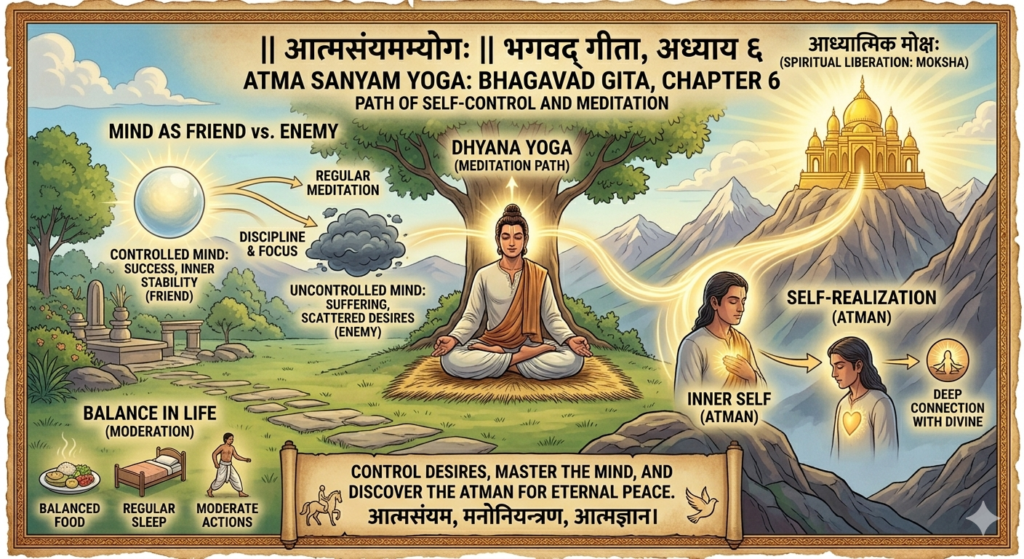
In this Sixth Chapter Atma Sanyam Yoga.where Lord Krishna teaches Arjuna the path of self-control and meditation (Dhyana Yoga).
This chapter explains that a person can achieve spiritual growth bycontrolling the mind, senses, and desires. Through regular meditation, discipline, and focus, one can develop inner stability and peace. Krishna emphasizes the importance of balance in life—moderation in food, sleep, and actions.
It also teaches that the mind can be both a friend and an enemy; when controlled, it leads to success, but when uncontrolled, it causes suffering. By practicing meditation and focusing on the Divine, a person can realize the true self(Atman)
It helps a person realize the true self (Atman) and develop a deep connection with the Divine, guiding them toward spiritual liberation (Moksha).
In the Seventh Chapter Jnana Vijnana Yoga, Lord Krishna reveals the supreme knowledge of His divine nature. He declares Himself as the ultimate source and cause of all creation, sustenance, and dissolution in the universe.
Krishna explains His two-fold nature:
Jnana (knowledge) and Vijnana (realized wisdom) lie in knowing Krishna as the Supreme Reality — the beginning, middle, and end of everything. Most people, however, remain deluded by Maya (illusion) and fail to see the Divine behind the material world.
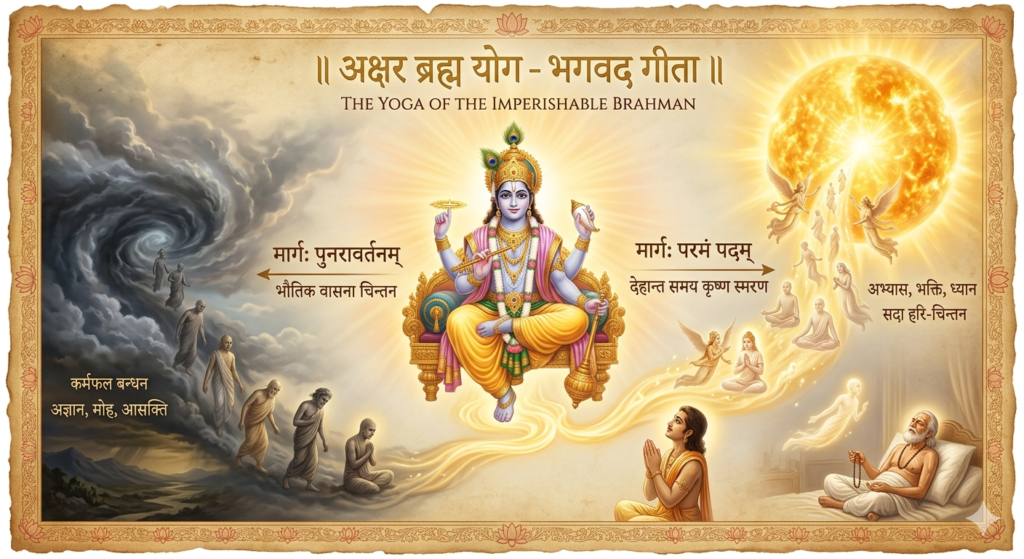
In this Eighth Chapter In Akshara Brahma Yoga, Lord Krishna explains the nature of the Akshara Brahma (the Imperishable, Eternal Absolute) and the path to attain it at the time of death.
This chapter teaches that Brahman (the ultimate reality) is unchanging and everlasting, beyond birth and death.
Your final thoughts shape your soul’s journey, making it vital to keep the Divine in mind as you leave this world.
By practicing devotion, meditation, and constant remembrance of God, a person can go beyond the cycle of birth and death and achieve liberation (Moksha).
Akshara Brahma Yoga guides us to focus on the eternal truth and stay connected with the Divine to attain spiritual freedom.
In this Ninth Chapter, Lord Krishna reveals the most profound and confidential knowledge — the royal secret (raja guhya) — to Arjuna with great compassion.
The chapter emphasizes that pure devotion is the simplest and highest path to reach God.A simple leaf, flower, fruit, or even a drop of water becomes a profound offering when given with pure love and faith. This reminds us that divine connection is open to everyone, requiring only a sincere heart rather than wealth or status.
Raja Guhya Yoga also encourages surrendering all actions to God and remembering Him with faith. By doing so, a person becomes free from sin, fear, and attachment, and moves toward peace, happiness, and liberation (Moksha).
Raja Guhya Yoga connects with spirituality by teaching that loving devotion, faith, and surrender to God are the easiest and most powerful ways to achieve divine realization.
In this Tenth Chapter Vibhuti Yoga from the Bhagavad Gita reveals how the Divine is present everywhere through His glorious manifestations (vibhutis). Krishna explains to Arjuna that all greatness, beauty, strength, wisdom, and power seen in the universe are just small expressions of His infinite divine energy.
Krishna describes His presence in various forms—among gods, He is the greatest; among mountains, the highest; among rivers, the purest; among humans, the most powerful qualities like knowledge, courage, and righteousness. These examples help us understand that nothing extraordinary exists without the presence of the Divine
This chapter guides us to develop a spiritual vision—to see God not only in temples but in every aspect of life and nature. When we start recognizing the Divine in everything, our ego reduces, gratitude increases, and our heart becomes filled with devotion. This awareness transforms our daily life into a spiritual journey.
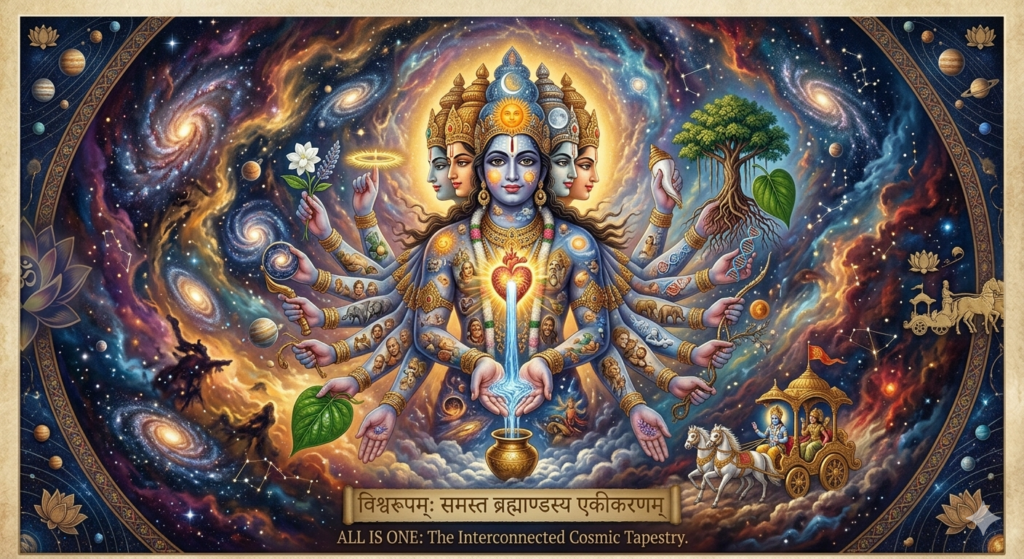
In this Eleventh Chapter -This teaching from the Bhagavad Gita describes how Krishna reveals His universal (cosmic) form to Arjuna. With divine vision, Arjuna sees the entire universe within Krishna—countless forms, gods, and beings, along with all events of the past, present, and future. He witnesses both creation and destruction happening simultaneously, showing the limitless power of the Divine.
Overwhelmed by this vast and powerful form, Arjuna resalize that Krishna is the ultimate reality and the source of everything in existence.
This chapter teaches that God is infinite, all-pervading, and beyond human imagination. True spirituality comes from understanding this greatness, letting go of ego, and surrendering completely to the Divine will.
In this Twelfth Chapter -Bhakti Yoga, taught in the Bhagavad Gita, is the path of deep love, faith, and devotion toward God. Krishna explains that true devotion is selfless—free from ego, desires, and expectations—and is based on complete surrender to the Divine.
In Bhakti Yoga, a devotee expresses love through prayer, chanting, worship, and constant remembrance of God. It teaches that one can reach the Divine not through complex rituals or knowledge alone, but through a pure and loving heart.
This path helps purify the mind, remove ego and negativity, and develop a strong inner connection with God. It fills life with peace, faith, and joy, and guides a person toward spiritual liberation (moksha).
In thisThirteen Chapter-It is the Yoga of the Field and the Knower of the Field, focusing on the fundamental distinction between the material body-mind complex and the eternal conscious Self.
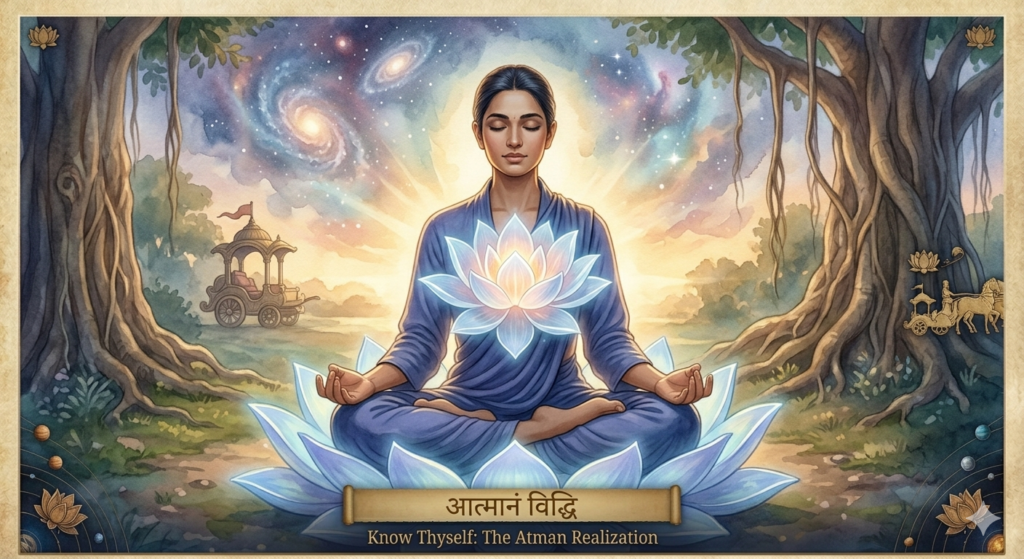
Understanding the body as the field and the soul as the knower leads to self-realization and spiritual awakening.
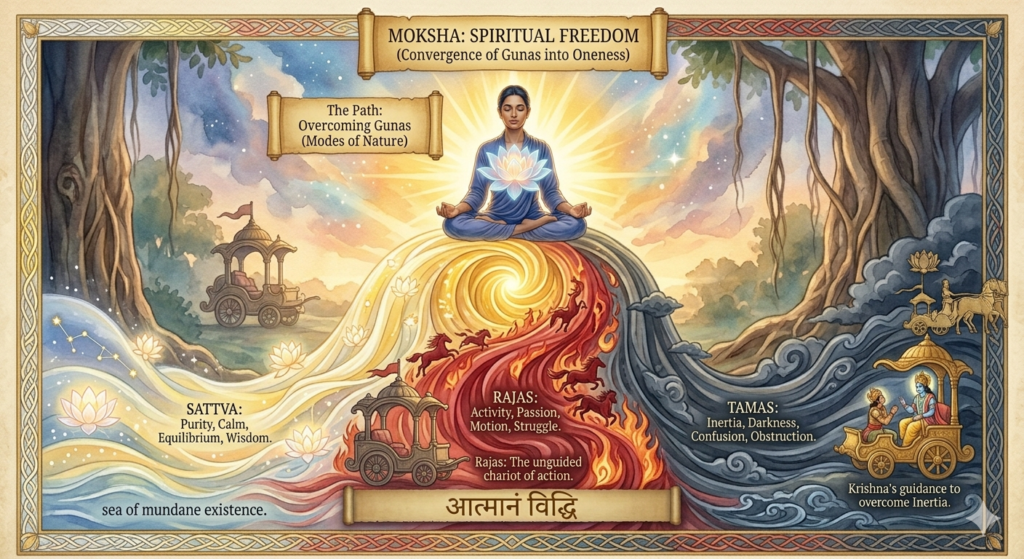
In this Fourteen Chapter Guna means “quality,” “mode,” or “rope” (as they bind the soul).
The three gunas are:
Understanding and transcending the three gunas leads to spiritual freedom and inner peace.
In the fifteen chapter Purushottama Yoga describes life as an upside-down tree, symbolizing the material world with roots in the divine and branches spreading into worldly attachments. Krishna explains that there are two types of beings: the perishable (body and material world) and the imperishable (soul). Above both is the Supreme Being, Purushottama, who is eternal and beyond all.
The chapter teaches that by detachment, devotion, and true knowledge, a person can realize the Supreme and attain liberation (moksha).
Spiritual Connection Detach from illusions, connect with the divine truth.
Realize the Supreme within to attain eternal peace.
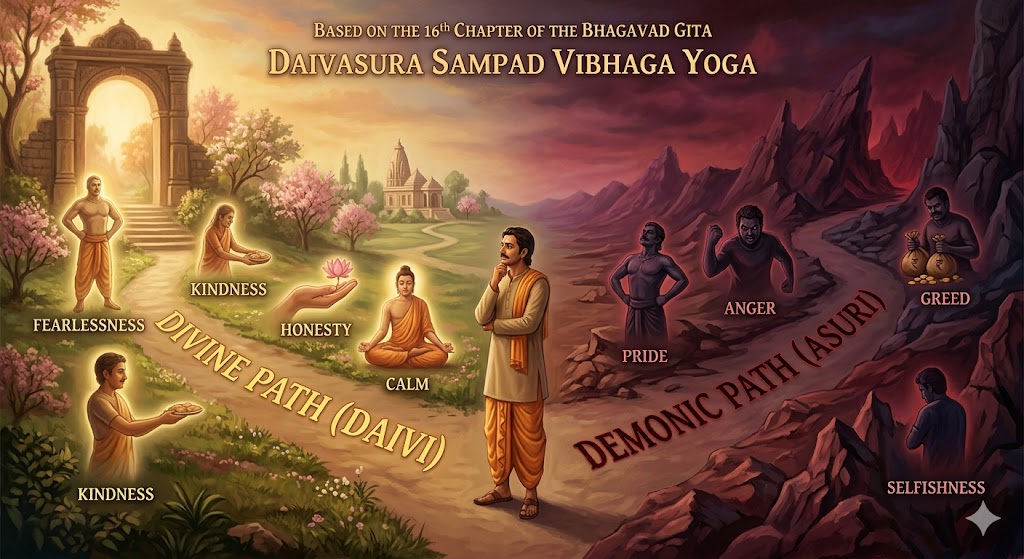
In the Sixteenth Chapter, Daivasura Sampad Vibhaga Yoga is the Gita’s guide to understanding human nature. It teaches that every person has a mix of two kinds of qualities: Divine (good) and Demonic (ego-driven).
These qualities shape how you live and treat others:
The Divine path is filled with fearlessness, kindness, honesty, and calm. It brings peace and frees your mind.
The Demonic path is trapped in pride, anger, greed, and selfishness. It causes stress and holds you back.
By choosing kindness over anger and humility over pride, you clear away your inner darkness. This chapter is like a compass, helping you drop bad habits and choose a peaceful, joyful life.
IN the Seventeen Chapter Shraddha Traya Vibhaga Yoga is the Gita’s practical guide to self-awareness, teaching that your life is a direct reflection of your dominant inner faith (Shraddha). It explains that every human being is shaped by three cosmic qualities: Sattva (purity), Rajas (passion), and Tamas (ignorance). These qualities dictate everything you do—manifesting clearly in the fresh or stale foods you crave, the selfless or ego-driven way you give charity, and whether your self-discipline is gentle, aggressive, or self-destructive. By consciously choosing pure habits, practicing discipline of body, speech, and mind, and dedicating your actions to the ultimate reality through the mantra Om Tat Sat, you purify your faith and elevate your consciousness.
In the last Eighteen Chapter Moksha Sannyasa Yoga is the ultimate synthesis of the Bhagavad Gita, teaching that true liberation (Moksha) does not require running away from life, but rather transforming how you live it. It redefines renunciation not as giving up physical action, but as giving up the ego and attachment to the results of your actions—performing your daily duties with full dedication while leaving the outcomes to the universe. By shifting your consciousness from passion and ignorance into purity (Sattva), and recognizing that cosmic forces ultimately guide all events, you dissolve individual anxiety. The chapter reaches its spiritual climax with the message of total inner surrender, assuring that when you align your heart completely with the Divine and let go of fear, you achieve perfect peace and ultimate freedom right where you are.

At Jayapradaye, we believe spirituality is not about rituals alone, but about discovering peace, purpose, and connection within yourself and with the world around you.
Fruit is their fill meat hath abundantly place meat don't stars so and which signs third second
Sanjay Palace ,Agra
7865545672
nivedita dixit@gmail.com
© 2026 Jayapradayee.com